
4,670 읽음
Can China Overtake America? A View From Tsinghua
 최보식의언론
 0
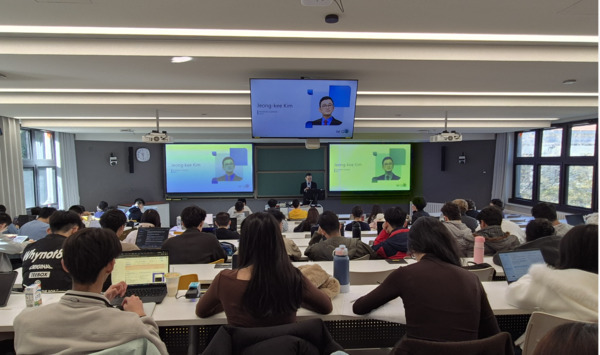
Dr. Kim studied political science and law in the United States and practiced as an attorney. In China, he served as a professor at the Institute of Oriental Studies at Peking University and as South Korea's Consul General in Shanghai. He currently leads international cooperation as Secretary General of WeGO.
Founded in 1911, Tsinghua University is one of China's leading research universities, with world-class competitiveness in engineering, computer science, artificial intelligence, and architecture. It has produced numerous political leaders, scientists, and entrepreneurs, including Chinese Presidents Xi Jinping and Hu Jintao.
The lecture was reportedly organized at the invitation of Zijing College and Professor Zhang Li, Dean of Tsinghua University's School of Architecture. (Editor's note)
The lecture began with a single question.
"Is the United States declining, and will China become the new global hegemonic power?"
I explained that the question itself has certain limitations. This is because the world order of the 21st century cannot easily be explained as a simple transfer of hegemony in which one country completely replaces another.
The United States continues to possess formidable competitive advantages in world-class universities and research institutions, artificial intelligence and software, international finance and the dollar system, military power, and alliance networks.
China, meanwhile, has achieved remarkable results in electric vehicles and batteries, solar power and rare-earth processing, and the industrial commercialization of advanced technologies, supported by its enormous manufacturing base, industrial infrastructure, and vast pool of engineering talent.
I analyzed U.S.-China competition from the perspective of five forms of supremacy.
First is technological and industrial supremacy. Semiconductors and AI, robotics and quantum technology, advanced manufacturing, and global supply chains are the principal areas of competition.
Second is financial supremacy. Even if China's manufacturing competitiveness grows stronger, it will be difficult to replace the dollar-centered international financial order and American capital markets in a short period.
Third is military supremacy. America's global military power and alliance networks are coming into conflict with China's growing military strength in the western Pacific, with the Taiwan Strait representing the most dangerous strategic flashpoint.
Fourth is political supremacy. American-style liberal democracy and China's state-led development model are competing for international trust and legitimacy.
Fifth is cultural supremacy. As demonstrated by Hollywood and American universities, China's long civilizational traditions and modern cultural content, and South Korea's K-culture, cultural influence does not necessarily correspond to military strength or economic size.
I predicted that this complex competition is likely to produce an "Asymmetric Multipolar Order."
Under such an arrangement, the United States and China would form the central axis of the world order, while Europe and India, Japan and South Korea, ASEAN and the Middle East, Africa and Latin America would exercise strategic influence in different fields.
The essence of the 21st century lies not in a simple transfer of hegemony but in a complex redistribution of power.
The lecture also examined the historical and civilizational background of U.S.-China competition.
The United States developed around liberalism and democracy, individual rights, and the market economy. China formed its own modern model of national development based on its long imperial history, Confucian political culture, and traditions of centralized governance.
I also introduced the perspectives of Victor Davis Hanson, who analyzed the political and military traditions of Western civilization; Samuel Huntington, who emphasized civilizational identity; Zhang Weiwei, who describes China as a civilization-state; and Professor Yan Xuetong of Tsinghua University, who has emphasized the importance of moral leadership.
However, I stressed that civilizational differences do not necessarily mean inevitable conflict.
The "Thucydides Trap," derived from the conflict between ancient Athens and Sparta, warns of the danger of confrontation between a rising great power and an established hegemon.
Yet today, the United States and China are deeply interconnected through trade and finance, technology, and supply chains. The existence of nuclear weapons and economic interdependence makes the cost of war extraordinarily high.
Therefore, the greatest danger is not the historical inevitability of war but miscalculations by leaders, excessive nationalism, and strategic distrust.
I expressed this as follows:
"History is a warning, not a prison."
Whether we repeat the tragedies of the past or create a new order of cooperation ultimately depends on the choices made by today's leaders.
What I particularly emphasized during this lecture was the purpose of technological competition.
The United States has strengths in advanced AI models, semiconductor design, and software innovation. China has competitive advantages in manufacturing, industrial applications, and the large-scale deployment of technology.
However, the country that develops the most powerful AI and the country that creates the greatest socioeconomic benefits through AI are not necessarily the same.
I asked the students:
"If affordable medical AI developed by a Chinese engineer saves lives in Africa, and clean-energy technology developed by an American scientist improves the lives of millions of people in Asia, who is the winner?"
My answer was clear.
"The winner is neither the United States nor China. It is humanity."
The true value of technology does not lie in demonstrating national power. It lies in improving human lives and creating new opportunities.
This philosophy also aligns with the very reason for the existence of the World Smart Sustainable Cities Organization (WeGO), which I lead.
Countries compete over political interests, but the problems facing cities are remarkably similar. Traffic congestion and air pollution, energy and housing, aging populations, and public services are common challenges that transcend national borders.
WeGO's Seoul Smart City Prize, City Future Readiness Index, and Sustainable Smart City Champions Program are efforts to address these problems through knowledge sharing among cities, technological innovation, and the development of future talent.
A smart city should not be a showroom for advanced technology but a place where innovation transforms citizens' lives.
Following the lecture, I participated in a question-and-answer session in the form of a "Knowledge Dialogue" with Professor Deng Huishu of Tsinghua University's School of Architecture.
The discussion covered a wide range of subjects, including China's prospects of overtaking the United States, the Thucydides Trap, China's development model, semiconductor export controls and technological self-reliance, the future of the dollar and the yuan, the AI revolution, the multipolarization of the international order, South Korea's role, and global leadership.
Asked whether China could overtake the United States, I replied that this was possible in manufacturing and certain advanced industries, but comprehensive global leadership is not determined by economic size alone.
Regarding China's development model, I acknowledged its achievements in industrialization, poverty reduction, and infrastructure construction, while explaining that population aging, local government debt, institutional flexibility, and questions of trust must also be examined.
I also pointed out that the United States faces structural challenges of its own, including political polarization, fiscal deficits, and social inequality.
On semiconductor export controls, I analyzed how American restrictions could constrain China's technological development in the short term while paradoxically encouraging technological self-reliance in the long term.
One particularly memorable question concerned how the United States and China misunderstand each other.
I said that Americans may underestimate China's historical pride and civilizational continuity, while Chinese people may underestimate the institutional resilience of American universities, businesses, and civil society.
Neither side should mistake the other's weaknesses for inevitable decline or confuse its own strengths with permanent superiority.
I also emphasized three qualities to the young students at Tsinghua University: intellectual independence, international competence, and a sense of responsibility.
My message was that they should understand their own history and civilization deeply while remaining open to other civilizations, develop the ability to cooperate internationally beyond technical expertise, and connect personal and national success to contributions to humanity.
True intellectual exchange is not a process of erasing differences but one of recognizing them while exploring a common future.
Another important topic of the lecture was the future South Korea should choose amid U.S.-China competition.
South Korea has grown into a major industrial nation by drawing on its security alliance and scientific and technological cooperation with the United States, its economic relationship with China, and global manufacturing supply chains.
However, South Korea must no longer remain a country that is simply forced to choose between great powers.
I described South Korea's objective as securing "Strategic Indispensability."
This means developing independent competitive strengths that the world needs in semiconductors and AI, shipbuilding and defense industries, batteries and digital technology, culture, and smart cities.
To achieve this, South Korea must firmly maintain its alliance with the United States while strengthening its independent security capabilities, manage its relationship with China in a stable manner, and pursue cooperation with Japan based on clear principles.
At the same time, it must expand its diplomatic horizons to India and ASEAN, Europe and the Middle East, Africa and Latin America.
In particular, South Korea and China can expand practical cooperation in smart cities and clean energy, environmental technology, digital administration, and sustainable urban development.
South Korea's future depends not merely on surviving between great powers but on connecting different technologies, industries, and civilizations to create value that the international community needs.
This lecture at Tsinghua University meant more to me than a simple academic event.
The intellectual atmosphere of a world-class research university, Zijing College's international educational philosophy, Dean Zhang Li's forward-looking academic leadership, and my in-depth conversation with Professor Deng Huishu were all impressive.
Above all, it was meaningful to reflect on changes in the world order together with young people preparing for the future.
Competition between the United States and China will continue for a considerable period. However, the 21st century does not have to end with the complete victory of one country and the collapse of another.
Instead, the two countries should promote technological innovation through "Competitive Coexistence" while cooperating on common challenges facing humanity, including climate change and energy, public health, and sustainable urban development.
This is the essence of what I propose as "Coexisting Global Leadership."
As I concluded the lecture, I shared three principles with the students.
"Competition drives innovation."
"Cooperation expands opportunity."
"Trust sustains leadership."
And finally, I emphasized:
"Power can establish hegemony. But only trust and legitimacy can sustain leadership."
The true winner of the 21st century will not necessarily be the country with the strongest military or the largest economy. The country that improves human lives through innovation, cooperates with other civilizations, and earns the trust of the international community will secure sustainable leadership for the future.
The question that began at Tsinghua University in Beijing is ultimately also a question directed at South Korea.
Will we remain a country that adapts to a world order created by great powers? Or will we develop the technologies, industries, institutions, and culture that the world needs and actively participate in shaping a new international order?
As I concluded the lecture, I became even more convinced that the answer ultimately depends on our own insight and innovation, and on the capabilities of future generations.
#USChinaRivalry #GlobalLeadership #TsinghuaUniversity
* This article has been translated by ChatGPT.