
886 읽음
이재명 호르무즈 파병 검토, 국내용 국면 전환 의혹 분석
 최보식의언론
 3
3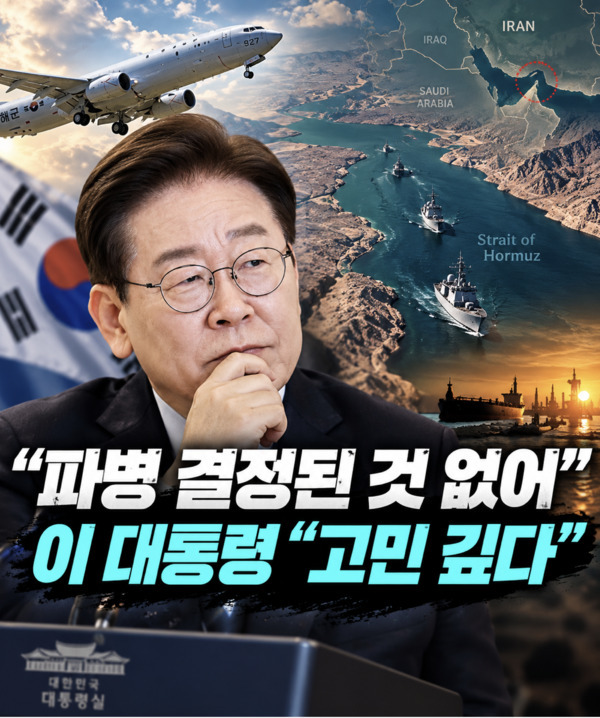
The momentum behind the administration has collapsed amid the failure of its real estate policies and the plunge in KOSPI stock prices. In an attempt to reverse the situation, the president carried out a reshuffle involving six ministries, but instead of solving one problem, he ended up creating an even bigger one, worsening the situation and blocking any avenue of retreat for the administration. At such a moment, the president’s job approval rating is plunging sharply, much like the KOSPI itself.
The administration’s retreat has been blocked, and its exit has disappeared. Meanwhile, the push for a semiconductor industry in the Honam region is also becoming more difficult due to the failure of diplomacy with the United States. President Trump’s remark telling South Korean semiconductor companies to invest in the United States, along with his statement that he would not forget and would certainly remember South Korea—an ally that responded with “No thanks” when the United States asked for help regarding Iran—must have placed considerable pressure on the administration.
There was likely a calculation that this was the moment to find a new way out while simultaneously easing the pressure coming from the United States. However, neither the United States nor the international community will have any “trust” in President Lee’s consideration of a deployment to Hormuz.
From the standpoint of President Trump and his White House advisers, who are closely watching President Lee’s approval ratings fall, they will likely recognize that his remarks are largely perfunctory. The newly appointed U.S. ambassador to South Korea will presumably be reporting in detail on the domestic political situation, allowing Washington to understand what is happening inside South Korea at a glance.
The United States had already been aware since Lee’s presidential campaign that one of its leading allies in Asia was leaning toward China, its challenger for global hegemony. After observing his actions since taking office and becoming convinced that he is a pro-China, anti-American figure, U.S. trust in him is likely at zero.
One more point should be added. His conduct thus far—delaying investment in the United States that resulted from tariff negotiations with Washington and seemingly attempting to avoid such investment by dragging out the process—will only reconfirm that there is little more to expect from him.
Even if the Blue House signals that it is considering a deployment to Hormuz, no one knows whether it would take months or years before a substantive deployment at the level expected by the United States could actually take place. For that reason, the White House is unlikely to place much expectation on statements from the Blue House about deploying troops to Hormuz.
The direct reason is that such a deployment requires the consent of the National Assembly. The administration will therefore be able to make the excuse that even if the Blue House wants to dispatch troops quickly, it cannot do so because the National Assembly refuses to approve it.
The Blue House’s statement that it is “reviewing ways to make a substantive contribution” was soon juxtaposed with the statement that “nothing has yet been decided.” Why say that “nothing has been decided”? It is intended to redirect public attention.
A Blue House official reportedly mentioned “various options, including combat participation, non-combat roles, and search operations.” But why announce such possibilities now when no decision on deployment has even been made? The Blue House also said, “Whether one person goes or two, if they are sent to the scene, it is defined as a deployment.”
Why, then, write such a story about something that has not even been decided and spread empty words to the international community? Is the administration dangling bait before the White House? Or is it trying to divert public attention from falling approval ratings caused by domestic personnel appointments and the Cabinet reshuffle?
Under the current circumstances, does anyone really expect the Democratic Party and progressive parties to support such a deployment? If so, will raising the Hormuz deployment issue strengthen or weaken solidarity within the administration’s own camp, which has already been given personnel appointments as bait in an effort to consolidate its core supporters?
The Blue House is an organization devoid of strategy, lacking strategic deliberation over the issues it chooses to announce. Its approach to governing resembles trying to get through one meal at a time, operating the country with an IQ almost at the level of a goldfish.
Can it secure the constitutionally required consent of the National Assembly? That is why many citizens suspect that the Hormuz deployment issue itself may be nothing more than a “deception aimed at the public.”
The Blue House’s explicit statement on the 4th that “domestic legal procedures ultimately mean consultations with the National Assembly and obtaining the National Assembly’s consent” likewise amounts to sending Washington the message: “The president wants to deploy troops, but he cannot because the National Assembly opposes it.”
At this point, the Hormuz deployment issue will become yet another negative factor that further undermines President Lee’s credibility both at home and abroad. Regardless of whether they are conservative or progressive, public resistance to President Lee will grow even stronger.
The Hormuz deployment issue will now become an additional factor worsening public sentiment over the Chuseok holiday and will further fuel talk of an “October crisis.”
#HormuzDeployment #LeeJaeMyung #SouthKoreaUSRelations
* This article has been translated by ChatGPT.