
820 읽음
MF Warning: South Korea’s National Debt Already at Risk Level
 최보식의언론
 0
0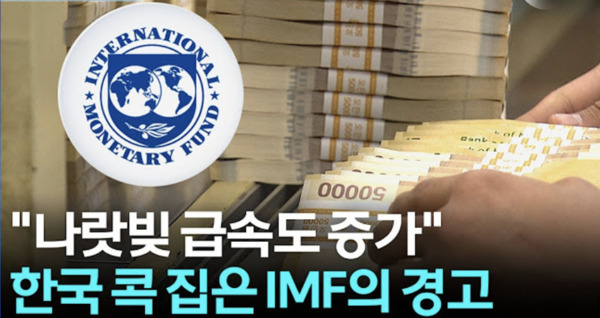
It singled out South Korea, along with Belgium, stating that a “significant” increase is expected—an assessment that goes beyond its previous expression of a “gradual rise.”
The IMF projects that South Korea’s general government debt (D2) will reach 63.1% of GDP by 2031, exceeding the 60% threshold commonly regarded as a benchmark for fiscal soundness.
Despite this warning from an international organization, the government has not presented any concrete response plan.
The administration has already announced, through its national fiscal management plan, that it will expand national debt to 1,789 trillion won, or 58.0% of GDP, by 2029. In its long-term fiscal outlook, it even projected that the debt ratio could rise to 156.3% of GDP by 2065.
The core issue is the absence of mechanisms to curb this rapid fiscal expansion.
Most OECD countries operate fiscal rules, yet South Korea has no plan to adopt one. According to the IMF, as of the end of 2024, 120 countries have implemented fiscal rules, while South Korea remains among just four countries—including Niger, North Macedonia, and South Africa—that have not.
The government’s expansionary spending stance is also expected to continue. It recently pushed for an additional 26.2 trillion won in spending under the justification of a “wartime supplementary budget,” despite no actual war, and without restructuring existing expenditures.
President Lee Jae-myung himself has stated, “If the government doesn’t spend money at times like this, when will it? Saying the country must not take on debt is ignorant.” This remark alone reveals the administration’s perception of fiscal policy.
This approach recalls the Moon Jae-in administration, which significantly expanded fiscal spending under the pretext of COVID-19. At the time, although there were controversies over possible underreporting, the government still presented a long-term plan to manage debt at 81.1% of GDP by 2060.
Now, even that level of discipline appears absent.
There are no control mechanisms, no clear standards, and not even a sense of urgency about the issue.
Fiscal systems, once destabilized, are difficult to restore. If action is not taken now, the burden will ultimately fall on future generations.
At the very least, a fiscal rule must be introduced to set clear limits on debt growth, and a comprehensive restructuring of expenditures must be carried out.
Delay will only eliminate the possibility of choice.
#SouthKoreaDebt #FiscalCrisis #IMFWarning